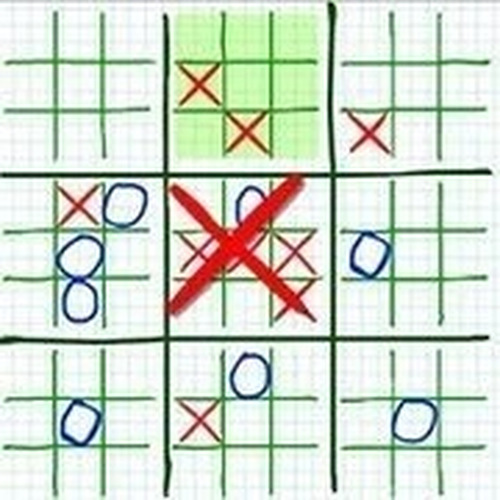
Nine Boards, One Goal
Tactical Tic-Tac-Toe takes the familiar three-by-three grid and multiplies it into nine smaller boards arranged in a larger three-by-three layout. Your objective is to win three mini boards in a row—horizontally, vertically, or diagonally—before your opponent does. Each mini board functions as its own tic-tac-toe match, but the outcome of those smaller games determines control of the larger grid. This layered structure means every placement carries weight beyond the immediate square.
The Forced-Move Mechanic
What separates this game from standard tic-tac-toe is the board-selection rule. You cannot choose which mini board to play on next. Instead, the position of your opponent's last move dictates where you must play. For example, if they place a mark in the top-left corner of a mini board, your next move must be in the top-left mini board. This constraint removes free choice and replaces it with a need to anticipate how your current move will limit or enable your opponent's options. The mechanic transforms a simple game into one where foresight matters as much as pattern recognition.
Accessible Rules, Deep Play
The rules take only a minute to learn, which makes the game approachable for players of all ages. Yet the forced-move system creates a strategic depth that rewards planning several turns ahead. You are not just trying to win a single mini board; you are trying to set up multiple threats while managing where your opponent can respond. Because the board selection is tied to each move, no two matches unfold the same way. Players who enjoy puzzles and abstract strategy will find that every session demands a fresh approach.
Practical Tips for Better Play
Control of the center mini board often provides more options, so prioritize winning it when possible. Think about how your move will force your opponent's next placement—sometimes a seemingly weak move can steer them into a difficult position. Setting up two threats at once makes it harder for them to block both. Regular play helps you recognize patterns and improve your ability to adapt, but the core challenge remains the same: stay flexible and plan ahead.








Editorial Notes